LIGO Today
Listen to the Universe
A modern guide to LIGO, gravitational waves, cosmic collisions, and open science data.
Live science dashboard
Where gravitational-wave science stands
A mix of point-in-time snapshots and live external links to official sources. Snapshots reflect the latest catalog; links go to current data.
What LIGO does
A new way to observe the cosmos
LIGO opened a window on the universe that telescopes cannot see — by measuring spacetime itself.
Detects waves, not light
LIGO senses gravitational waves — tiny ripples in spacetime from violent cosmic events — rather than electromagnetic light.
Laser interferometers
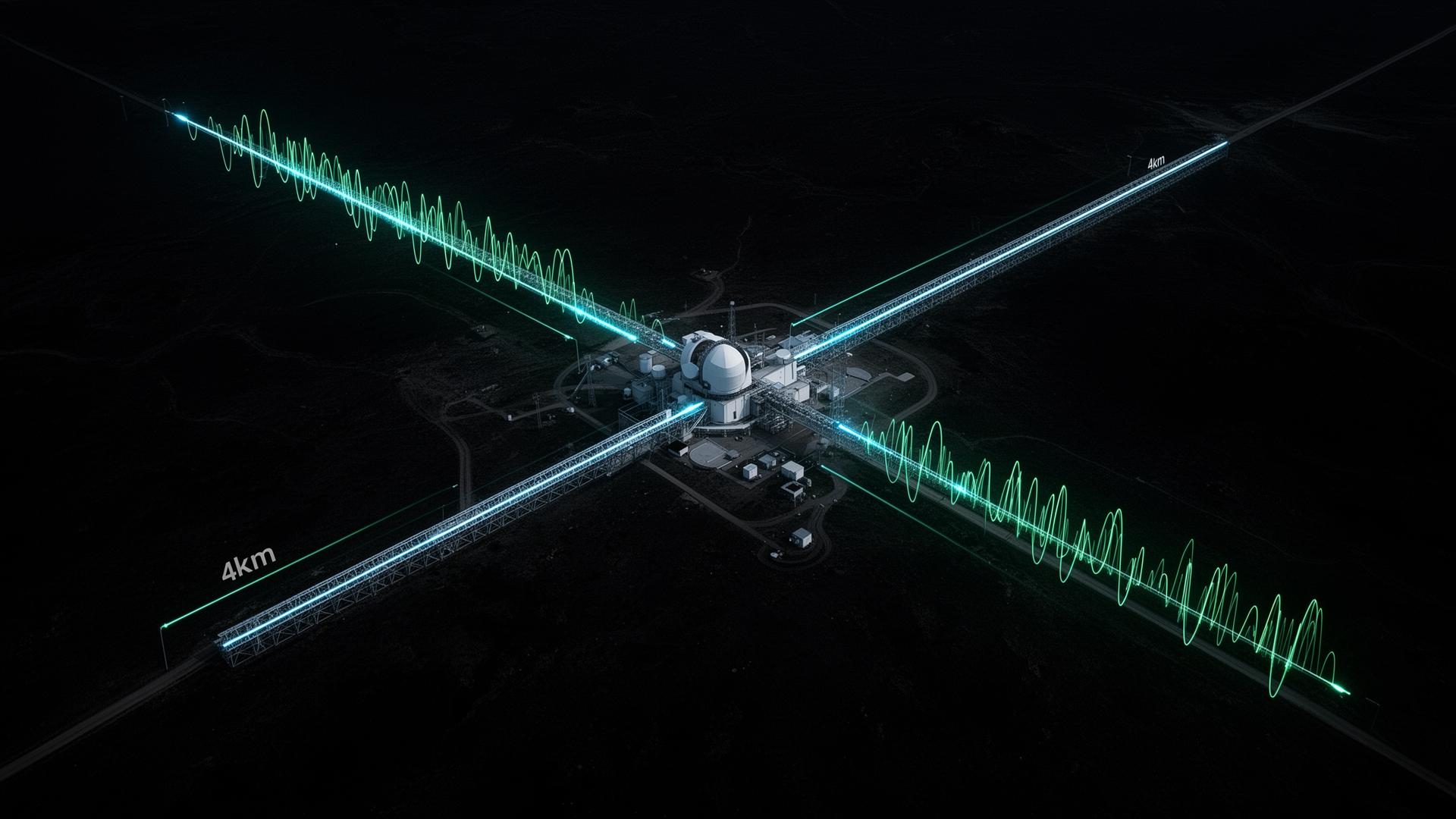
Each detector splits a laser beam down two perpendicular 4 km arms and measures minute differences when they recombine.
Two US detectors
The American observatories sit in Hanford, Washington and Livingston, Louisiana, roughly 3,000 km apart.
A global network
LIGO works with Virgo, KAGRA, and future LIGO-India so detections can be confirmed and located across the sky.
How it works
Inside a laser interferometer
Move the slider to see how a passing gravitational wave stretches one arm while squeezing the other, producing a measurable signal.
Drag the slider to simulate a passing wave. As spacetime stretches one arm, it squeezes the other. The recombined laser light shifts, and the detector reads out that tiny change as a signal.
Laser source
A stable laser beam enters the instrument.
Beam splitter
The beam is split and sent down two perpendicular arms.
4 km arms & mirrors
Light bounces between mirrors at the ends of each arm.
Detector output
Recombined light reveals tiny length changes from a wave.
Discoveries
A century from prediction to detection
Key milestones in gravitational-wave science, with sources where available.
- 1916
Einstein predicts gravitational waves
General relativity implies that accelerating masses ripple spacetime, sending waves outward at the speed of light.
Source: LIGO science - 1974
Hulse–Taylor binary pulsar
A decaying pulsar orbit matched the energy loss expected from gravitational waves, offering the first indirect evidence.
- Sep 14, 2015
First direct detection (GW150914)
LIGO recorded the merger of two black holes — the first direct observation of gravitational waves.
Source: Event catalog - 2017
Nobel Prize in Physics
The prize recognized decisive contributions to the LIGO detector and the observation of gravitational waves.
- 2017
GW170817 — multi-messenger astronomy
A neutron-star merger was seen in gravitational waves and light, launching multi-messenger astronomy.
Source: Event catalog - 2025
O4 observing run completed
The fourth observing run wrapped up, expanding the catalog of confirmed transient sources.
- 2026
GWTC-5.0 catalog released
The latest transient catalog reached 390 confirmed gravitational-wave events.
Source: GWOSC - 2030 (target)
LIGO-India first observations
A new detector in India aims to sharpen sky localization across the global network.
Observatory network
A planet-spanning detector array
Multiple detectors on different continents let scientists confirm signals and triangulate where in the sky an event occurred.
LIGO Hanford
Hanford, Washington
LIGO Livingston
Livingston, Louisiana
Virgo
Cascina, near Pisa
KAGRA
Kamioka, Gifu
LIGO-India
Hingoli, Maharashtra
LIGO Hanford
United States
4 km dual-arm interferometer in the Pacific Northwest.
Operational
LIGO Livingston
United States
4 km interferometer ~3,000 km from Hanford.
Operational
Virgo
Italy
3 km European detector run by the EGO consortium.
Operational
KAGRA
Japan
Underground, cryogenic 3 km interferometer.
Operational
LIGO-India
India
Planned 4 km detector to widen the global network.
Under construction
News & updates
Latest from official sources
Short, original summaries that link out to official announcements.
GWTC-5.0 catalog release
The latest Gravitational-Wave Transient Catalog adds new candidate sources, bringing the confirmed total to 390 events.
Read at GWOSCLIGO-India groundbreaking
Construction milestones advance for the planned detector in Maharashtra that will extend the worldwide observing network.
Read at LIGO CaltechO4 observing run completed
The fourth observing run concluded, with data feeding into updated catalogs and open data releases.
Read at LIGO CaltechOpen data
Public data, tools, and catalogs
The Gravitational Wave Open Science Center (GWOSC) provides public strain data, tutorials, software, event catalogs, and a documented API.
GWOSC data is public, CORS-enabled, and requires no authentication. It provides downloadable datasets and an API — not real-time webhooks. Learn more at GWOSC.
Learn
A path for every audience
Curated routes into gravitational-wave science, linking to official educational resources.
For curious readers
Start with plain-language explainers on what gravitational waves are and why they matter.
For students
Hands-on notebooks and tutorials that let you analyze real detector data.
Gallery
Imagery & visuals
A small curated set with credits. Official imagery is courtesy of Caltech/MIT/LIGO Laboratory unless otherwise noted.